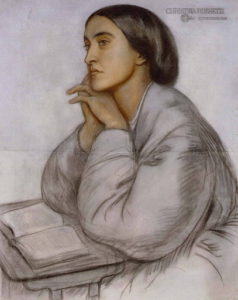
Poet Christina Rossetti was born on December 5, 1830, in London to a family of brilliant artists and literary scholars. The portrait above was made by her older brother, the famous painter Dante Gabriel. She was the author of many books and poems, most notably “Remember” (1849), Goblin Market and other Poems (1862), and The Prince’s Progress (1866).
She also wrote the poem “A Christmas Carol,” which you may recognize by its later title, “In the Bleak Midwinter” (1872):
In the bleak midwinter
Frosty wind made moan,
Earth stood hard as iron,
Water like a stone:
Snow had fallen, snow on snow
Snow on snow,
In the bleak mid-winter,
Long ago.
Our God, heaven cannot hold him
Nor earth sustain;
Heaven and earth shall flee away
When he comes to reign:
In the bleak mid-winter
A stable-place sufficed
The Lord God Almighty
Jesus Christ.
Enough for him, whom cherubim
Worship night and day,
A breastful of milk,
And a mangerful of hay:
Enough for him, whom angels
Fall down before,
The ox and ass and camel
Which adore.
Angels and archangels
May have gathered there,
Cherubim and seraphim
Thronged the air –
But only his mother
In her maiden bliss
Worshipped the beloved
With a kiss.
What can I give him,
Poor as I am?
If I were a shepherd
I would bring a lamb;
If I were a wise man
I would do my part;
Yet what I can, I give him –
Give my heart.
Profound simplicity. By all accounts, that was Rossetti’s greatest gift. Bleak, ice-hardened winter, contrasted with the soft warmth of a mother’s kiss. The Almighty God, who is worshiped day and night by mysterious beings in heaven is now content to lie in hay, surrounded by livestock. The One who deserves humanity’s richest gifts asks only for my heart.
Scholar Chene Heady observed that Rossetti’s poems are not unlike the parables of Jesus in that they are “sufficiently complicated as to seem simple to the hearer who misses the point.” Beneath their apparently plain surface, rich truths and deep emotion lie in wait to be discovered. As it turns out, the same is true of the poet herself.
As a contemporary of the great Emily Dickinson, it is remarkable that many critics have praised Christina Rossetti as the superior poet of the 19th century.* Despite her unmatched talent and rising fame, Rossetti committed herself to a life of seclusion and quiet devotion to Christ. Her faith is evident in the substance of her writings, which teem with biblical themes such as human frailty, the vanity of earthly pleasures, and God’s perfect love.
We can catch a glimpse of her humble character in a letter she wrote to her brother near the end of her life, in 1888:
“Beautiful, delightful, noble, memorable, as is the world you and yours frequent, I yet am well content in my shady crevice–which crevice enjoys the unique advantage of being to my certain knowledge the place assigned me.”
Her brother, in turn, described Christina’s life as “replete with the spirit of self-postponement.” The third stanza of her beloved Christmas song describes the contented spirit of the newborn Savior. Likewise, she was uncomfortable with fame; it was “enough” that she belonged to Jesus.
Rossetti often found inspiration in the symbolic images painted in nature. It is hardly accurate to describe the first Christmas in modern-day Palestine by piles of “snow upon snow… upon snow”! But in her poetic imagination, earth stood hard as iron (to borrow from another writer’s song) “in sin and error, pining.” After generations of famine–not of bread, but of the Word of God–a thick blanket, like a spiritual snow upon snow upon snow, had settled over humanity. The political, cultural, and even religious temperature had become ice-cold and resistant to the Spirit of God. Into that bleak midwinter entered the Savior who takes the most hardened hearts and makes them new.
Another characteristic that many have noted in Rossetti’s writings is what some would call a morbid obsession with death. This is especially mystifying when one reads about her personality in childhood, a vibrant light that her father described as a “storm” of joyful energy. Others in the family later remarked on the radical change in her, from a vivacious child to an “overscrupulous” adult. Biographers and historians have speculated that she may have suffered some sexual abuse around the age of 15.
Traumatic catalyst or not, we do know she suffered depression and disabling bouts of sickness throughout her life. From 1870 to 1872, she was brought to the brink of death by Graves’ Disease. One historian explained her case of Graves’ as “a condition characterized by fever, exhaustion, heart palpitations, stifling sensations, occasional loss of consciousness, violent headaches, palsied hands, and swelling in the neck that made swallowing difficult. Her hair fell out, her skin became discolored, her eyes began to protrude, and her voice changed.”
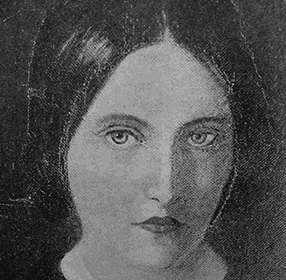
Another portrait by Dante Gabriel Rossetti.
Her brother, William, wrote that she “was an almost constant, and often a sadly-smitten, invalid.” She lived with an ever-present sense of her looming death, which may explain any morbid overtones heard in her writing. Her entire existence was an Advent season of longing. One can hear in her Christmas song both the serenity of freshly fallen snow and the painful moan of a cutting, frosty wind.
During her lifetime, she found warm shelter in the One who came “in the bleak midwinter, long ago.” In 1893, she was diagnosed with breast cancer, a sickness that ultimately carried her home to Jesus in 1894. Twelve years after her death, “A Christmas Carol” appeared in The English Hymnal, set to a melody composed by Gustav Holst under a title derived from the poem’s first line, “In the Bleak Midwinter.” Although other arrangements and settings of her poem exist, Holst so perfectly married the message and medium that his is the same familiar melody that many of us grew up singing, and still sing today.
“In the Bleak Midwinter” is a near-perfect Advent song. Like its author, it preaches Christ’s gift of peace in hardship; hope in longing; beauty in pain; and finding true contentment in a “spirit of self-postponement.” I want to encourage you to make every effort to arrive a little earlier than usual this Sunday. We will begin with a moment of reflection, with the first and last stanzas of Rossetti’s hymn setting the tone. Where has your love grown cold? Are there pains you have allowed to harden-over with icy bitterness? Will you entrust the longings of your heart to Him again?