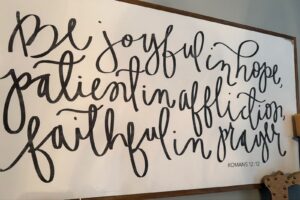
I love this sign that my wife placed above the piano in our house. Due to its prominent location in the living room, I have passed it thousands of times and spent hours meditating on its meaning, especially the phrase “patient in affliction.” What does Paul mean by the exhortation to suffer patiently?
Something I’ve learned from my experience with long-term, chronic affliction is that pain is an exceptionally competent teacher. Any fair-weather dolt can issue platitudes and judgments; one who refuses to sit under the tutelage of hardship will be unable to plumb the depths of wisdom. But the greatest teachers do more than transfer information; they incite their pupils to a lifelong, insatiable hunger for understanding. And so it happens that students of long-suffering pain are taught through many travails to ask insightful questions, like, “Why?”
“Why, God? Why would you allow this to happen to me? Why don’t you answer my prayers for healing? Why do you seem so distant? Why do I even bother praying, since you will do whatever you will, regardless of what I ask?”
“How long, O LORD? Will you forget me forever? How long will you hide your face from me? How long must I take counsel in my soul and have sorrow in my heart all the day? How long shall my enemy be exalted over me?”
Psalm 13:1-2
Patience in Affliction
The first point to note is that these questions do not necessarily reflect a lack of faith. In fact, these are pure and valid prayers for one who suffers faithfully, with patience. When we withhold these questions without ever voicing them to God, a root of bitterness will inevitably find its way into our hearts. It is far better to speak our complaints to the Father who loves us and already knows our need.
However, a second yet equally important point the Psalms of lament teach us is that every complaint should end with an affirmation of trust. We say, in essence, “God, this really stinks and I wish you would take it away! But you are good, and I trust your wisdom more than my own.” Psalm 13, which began above, ends with an assertion of confident trust: “But I have trusted in your steadfast love; my heart shall rejoice in your salvation. I will sing to the LORD, because he has dealt bountifully with me.”
Thirdly, true patience in affliction is active, not passive. In a sense, the difference is between surrendering to–and partnering with–God’s plan (i.e. “I will carry whatever you call me to carry, Lord!”) and giving up until He changes your circumstances (i.e. “I will not walk any further with you until you heal me”). Surrender reflects maturing faith; quitting reveals a growing root of bitterness that, when full-grown, produces hardened thorns of resentment, distrust, and spiritual apathy. Left unchecked, these will constrict the soul and choke out the voice of the Holy Spirit.
Fourthly, Paul’s injunction to be patient in affliction is bound on either side by joyful hope and faithful prayer. “Be joyful in hope, patient in affliction, faithful in prayer” (Rom. 12:12). To tie these ideas together, picture a sailboat with stabilizing outrigging.

It is able to traverse rough seas of affliction as the wind of the Holy Spirit is harnessed by the sail of faith. And our patience will not capsize as long as it is buoyed on the port side by joyful hope and, on the starboard side, by faithful prayer.
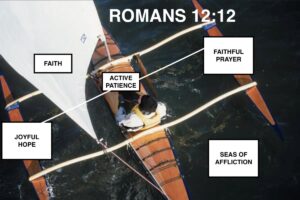
What is our joyful hope? Apart from Christ, the worldly can only see the present reality, so their hope is unsure, temporal, and prone to disappointment. But we who trust in Jesus can fix our eyes with hopeful certainty on a horizon that is sure, eternal, and unfailing. Whether in this life or in the life to come, we will be healed and given a reward so great that it will not be worth comparing to our present struggles.
“For this light momentary affliction is preparing for us an eternal weight of glory beyond all comparison, as we look not to the things that are seen but to the things that are unseen. For the things that are seen are transient, but the things that are unseen are eternal”
2 Corinthians 4:17
Buoying the other side of patience in affliction is faithful prayer. In perfect parallel with joyful hope, we can persevere through all manner of hellish wind and waves with serene patience only after we have learned to entreat the one who is strong to save. Our God may speak to the storm, “Peace, be still!” Or, in His perfect providence, He may bid the seas to rage and speak rather to our souls, “Peace, be still!” Either way, when we receive His answer with faith, it will steel our hearts with a renewed sense of purpose. To borrow from Victor Frankl’s famous quote: when we have a “why” to live–that is, when God says, “This is the way! Walk in it!”–we can endure any “how.”
“To pray is to accept that we are, and always will be, wholly dependent on God for everything.” – Tim Keller
Pain is a most competent teacher; affliction is an unpredictable and hostile sea. But, thanks be to God! His Word is our ballast, our tongue a rudder (for good or ill! See James 3), His joy, our hope, and His provision, our peace. When we raise the sails of faith, His Spirit will lead us through even the most treacherous waters, unscathed. And all of this is the gift of God; radical patience in pain is not within us, but entirely of grace.