Human beings have an innate longing to connect with the divine. Every civilization in history has left evidence of this in the form of monuments and writings. Temples were built on top of mountains; ziggurats, towers, and pyramids were erected in the belief that worshipers could ascend to the high places where heaven meets earth. All have some version of the creation story and describe how mankind can anger or please the divine power(s).
Similarly, there is a pattern throughout biblical history in which revelation and sacrifice frequently occur on mountains.1 Noah’s Ararat, Abraham’s Moriah, Moses’ Sinai, Elijah’s Carmel, David and Solomon’s Temple-Mount, Zion (Jerusalem), and so many others encounter God and make offerings on a mountaintop. The theme continues in the New Testament: the entire gospel of Matthew is structured around seven mountains. The gospel of John presents Jesus as the new and better mountain-temple (more on this in a moment). Jesus’ High Priestly prayer is offered in a garden on the Mount of Olives, and His work of atonement on Calvary’s mount. Heaven itself is pictured as a new Eden, God’s “holy hill.” We could go on.
However, there is at least one stark difference between the mountains of pagan worship and those of YHWH God in the Bible. Whereas the gods of this world would have their subjects carry their appeasing good works upward, the true and living God brought heaven down to earth and said, “Come as you are.” David Peterson ties this together beautifully: “The temple stood for revelation and purification: it was both the meeting-place of heaven and earth and the place of sacrifice for purification from sin. Thus, it found fulfilment in the incarnation and the sacrifice of Christ.”2
It is against this very background of historic mountain-temples that Jesus spoke to the Samaritan woman at the well. Literally—their conversation happened in plain view of Mount Gerizim, which Samaritans believed was the site of the true temple blessed by God. The setting looked something like this:
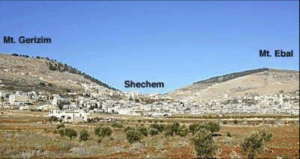
“The woman said to him, ‘Sir, I perceive that you are a prophet. Our fathers [the Samaritan people] worshiped on this mountain [gesturing towards Mt. Gerizim], but you [Jews] say that in Jerusalem [pointing south] is the place where people ought to worship.’” (Jn. 4:19-20)
Our familiarity with the narrative can cause us to miss the most message point here. After a lifetime of reading Jesus’ words apart from this mountain-temple context, His answer, “in spirit and truth,” will mean little more than some sentimental truism—something like, “Worship ought to be offered with feeling and genuine heart.” But that interpretation falls so far short of the point!
John does not intend to communicate anything about the worshiper’s existential feelings here. Far more profoundly, he is revealing Jesus as the fulfillment of every institution in Old Testament worship. Up to this point in his gospel, he has shown how Jesus is the true Tabernacle (Jn. 1:14), the Lamb of sacrifice (1:29), the Temple to be torn down and raised on the third day (2:19), and the Son of Man who must be “lifted up” like Moses’ serpent-staff (3:14-15).3 And so, when we come to chapter four and the Samaritan woman asks Jesus, essentially, “On which mountain-temple are we to worship?” Jesus answers, “I AM the temple-mountain in whom worship is rightly located.”
“Jesus said to her, ‘Woman, believe me, the hour is coming when neither on this mountain nor in Jerusalem will you worship the Father. You worship what you do not know; we worship what we know, for salvation is from the Jews. But the hour is coming, and is now here, when the true worshipers will worship the Father in spirit and truth, for the Father is seeking such people to worship him. God is spirit, and those who worship him must worship in spirit and truth.’” (Jn. 4:21-24)
It is semantically possible to translate the word “spirit” here as an impersonal wind or breath. Some have taken this approach in an attempt to explain Jesus’ statement as describing the essential otherness, or inner quality, of worship. But it was not Jesus’ mission to abolish all cultic expressions of worship in preference for individual, subjective experience.4 Historically, that way of thinking tends to run off the path of orthodox Christianity and into something more like New Age spiritualism.
Instead, when Jesus says that worship is to be “in spirit,” He is referring primarily to the Holy Spirit, who is the gift of salvation in Christ, interceding for the breath of life (spirit) within man. The Bible frequently speaks of the “indwelling” Holy Spirit (i.e., the Holy Spirit operating within the spirit of man) and John often uses water to symbolize that relationship.5
To bring us back to where we began, the thought that I hope you will carry with you into worship this Sunday is this: seek Jesus, not a “mountaintop” experience with Him. We do not impress God with our offerings; we do not work to appease God like the pagan nations, with their feverish flagellations and mantras. No, the mountain has come down to us! Every act of worship in Christ shines more brightly than the angels and resounds within the halls of the highest heavens! That is true, not because we feel it is so; as a Christian comedian from the 90’s used to say, goosebumps don’t always mean the presence of the Holy Spirit; sometimes it means you have the flu! But our “spirit and truth” worship is acceptable in His eyes because of the head-to-toe covering of Jesus’ righteousness, given to us by grace.
So, lean into Jesus! If His Spirit moves your spirit in such a way that results in tears and goosebumps, praise God! But in that case, you will have sought Him first and found Him with all the inward assurances added unto you as well. He is the treasure, the mountaintop, and the true Temple, the revelation and sacrifice of God! Praise Him!