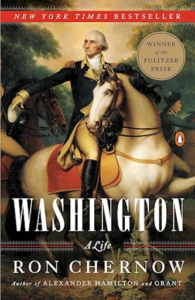
In anticipation of our nation’s semiquincentennial (whew, what a word!), I read a biography of our first President. Ron Chernow’s Pulitzer Prize–winning book, Washington: A Life, offers a balanced portrait of a man both larger than life and deeply human, with flaws. Standing just over six feet and known for his stately manner, Washington was an imposing figure—especially on horseback (as pictured above with his half-Arabian, “Blueskin”). And yet his apparent immortality on the battlefield, the serendipitous helps of nature, and several miraculous reversals of fortune have led many to believe that his success may not be attributed to the man, but to divine protection and favor.
Washington himself made frequent reference to his feeling that God had spared his life for a grand purpose. In a letter to Brigadier General Thomas Nelson, Jr., on August 20, 1778, Washington wrote, “The Hand of providence has been so conspicuous in all this, that he must be worse than an infidel that lacks faith, and more than wicked, that has not gratitude enough to acknowledge his obligations.”1 Later, in his first inaugural address, he stated his belief that “No people can be bound to acknowledge and adore the invisible hand which conducts the affairs of men more than the people of the United States.”2
During the French and Indian War, at the Battle of Monongahela (also known as “Braddock’s Defeat”), British General Edward Braddock led an expedition of about 1,300 men to capture the French Fort Duquesne (modern-day Pittsburgh), with then-colonel Washington serving as his aide-de-camp. A combined force of French troops and Indigenous allies ambushed Braddock’s column in dense forest. It was a bloodbath. Approximately 456 British soldiers and officers were killed, and an additional 421 were wounded, including General Braddock, who died days later from his wounds. The French and Indigenous side lost only 30-50 men in the battle.
As for Washington, he miraculously escaped the assault unharmed despite frequently riding through storms of musket fire in close quarters, rallying troops, delivering messages between officers, and fighting alongside his men. Two horses were shot from under him, but the man remained unscathed. Furthermore, this defeat ultimately benefited him, as it provided an invaluable education in unconventional warfare that would later influence his strategy in the Revolution. In the aftermath, it was observed that Washington’s coat and hat were riddled with musket ball holes, which “helped foster the belief [among native tribes and others] that he was under the protection of the Great Spirit.”3
In more than one episode of the Revolutionary War, Washington’s cause was aided by natural elements, such as sudden storms and high seas. In each instance, an enemy force’s advance was delayed, or the Continentals’ approach was enabled by nature’s intervention. Perhaps the most stunning of these accounts is the famous Christmas-evening crossing of the icy Delaware River.
Before that fateful crossing, things looked bleak for the American cause. Suffering a humiliating string of defeats, Washington’s army was reduced from 20,000 to 5,000 by death, desertion, and disease. Furthermore, many soldiers’ enlistments were about to expire, and all endured harsh winter conditions in tattered clothing, most without shoes, and with very little food. Morale was at an all-time low, and by all appearances, the American cause was one breath away from being snuffed out.
The British seized the moment and sent the largest armada in history to crush Washington and his ragtag Continentals. 400 British naval vessels carrying 32,000 men pushed the rebels out of New York, forcing them to retreat across New Jersey. Washington admitted in a letter to his brother, “The game is pretty near up.”
Washington decided to take a huge risk, for “victory or death.” On Christmas night, despite brutal weather conditions—freezing rain, sleet, and chunks of ice drifting in the water—he ordered a surprise crossing of men, horses, and artillery. It was a logistical nightmare that took the whole night to execute, setting them behind schedule well into the daytime and undermining the element of surprise. Providentially, despite the daylight, their movements across the river and subsequent 9-mile march to overtake the enemy at Trenton were obscured by the stormy conditions and dense fog.
The victory itself was not massive in scale, but its impact was enormous. It revived morale, convinced many soldiers to extend their enlistments, proved that the Continental Army was still in the fight, and set the stage for further successes, including the follow-up action at Princeton.
Chernow highlights several instances in which tragic circumstances beyond Washington’s control proved beneficial. The death of Washington’s invalid daughter just before the War began freed Martha to tend to her husband’s needs. The infamous betrayal of General Benedict Arnold could have resulted in Washington’s ruin. Instead, Arnold’s plot was exposed before it could cause damage; it unified and motivated the Americans, exposed security weaknesses, hurt British credibility, and garnered high respect for the Commander-in-Chief, who handled the crisis with the utmost composure. Likewise, battlefield defeats, the deaths of officers, and the scourge of disease were frequent catalysts for Washington’s improvement.
Reading about all the ways he was preserved and promoted despite such impossible odds reminded me that, ultimately, it is God who holds sway over world events and powers.
“He changes times and seasons; he removes kings and sets up kings; he gives wisdom to the wise and knowledge to those who have understanding” (Dan. 2:21).
“The king’s heart is like a stream of water directed by the LORD; he guides it wherever he pleases” (Prov. 21:1).
“Let every person be subject to the governing authorities. For there is no authority except from God, and those that exist have been instituted by God” (Rom. 13:1).
This weekend, give thanks to the Lord for His hand of providence, which has established, preserved, and (Lord willing) will continue to guide our great nation!
Briefly quoted above, I will close with the fuller text of Washington’s 1778 letter to Brigadier-General Nelson. Pray that the leaders of our nation resume such a humble posture!
“It is impossible to govern the world without God. It is the duty of all nations to acknowledge the Providence of Almighty God, to obey his will, to be grateful for his benefits and humbly implore his protection and favor. I am sure there never was a people who had more reason to acknowledge a divine interposition in their affairs, than those of the United States; and I should be pained to believe that they have forgotten that agency which was so often manifested during the revolution; or that they failed to consider the omnipotence of Him, who is alone able to protect them. He must be worse than an infidel that lacks faith, and more than wicked, that has not gratitude enough to acknowledge his obligations.”1
1 Letter to Brigadier-General Nelson, 20 August 1778, in Ford’s Writings of George Washington (1890), vol. VII, p. 161.
2 The fuller context of this excerpt from Washington’s First Inaugural Address (1789) is well worth your time:
“It would be peculiarly improper to omit in this first official act my fervent supplications to that Almighty Being who rules over the universe; who presides in the councils of nations; and whose providential aids can supply every human defect, that His benediction may consecrate to the liberties and happiness of the people of the United States a Government instituted by themselves for these essential purposes, and may enable every instrument employed in its administration to execute with success the functions allotted to his charge.
In tendering this homage to the Great Author of every public and private good, I assure myself that it expresses your sentiments not less than my own; nor those of my fellow-citizens at large less than either. No people can be bound to acknowledge and adore the invisible hand which conducts the affairs of men more than the people of the United States.”